How To Start Strength Training After 40: A Beginner-Friendly Guide For Women
Starting strength training after 40 might feel a little intimidating if you haven’t done it before, but it can be one of the simplest and most effective ways to support your strength, mobility, and overall health.
And no, 40 is definitely not too late to start.
Whether you’re completely new to weights, returning to exercise after a long break, or simply want to feel stronger in everyday life, you don’t need to spend hours in the gym or lift incredibly heavy weights to get started.
In this guide, I’ll walk you through how to start strength training after 40, including the best beginner exercises, how often to train, how much weight to use, and how to progress without making things unnecessarily complicated.
The goal isn’t to become the strongest person in the gym. It’s to build strength gradually, feel more confident, and create a routine you can actually stick with.
Table of Contents
- Why Start Strength Training After 40?
- Is 40 Too Late to Start Strength Training?
- Benefits of Strength Training After 40
- 5 Basic Strength Exercises for Beginners Over 40
- How to Get Started Safely
- How Much Weight Should a Beginner Lift?
- A Simple Beginner Strength Training Workout
- How Often Should a 40-Year-Old Lift Weights?
- Can You Strength Train Every Day?
- How to Progress Your Strength Training
- Helpful Tips and Common Challenges
- Frequently Asked Questions
Why Start Strength Training After 40?
Your 40s can be a great time to start strength training.
As we get older, maintaining muscle strength becomes increasingly important. Regular resistance training can help you maintain and build muscle, support strong bones, improve physical function, and make everyday activities easier.
Think about things you do without giving them much thought:
- Carrying groceries
- Climbing stairs
- Getting up from a chair
- Lifting a suitcase
- Picking something up from the floor
- Playing with your children or grandchildren
Being stronger can make all of these things feel easier.
Strength training can also support balance and mobility as you age. And perhaps one of the biggest benefits is confidence. When you notice that something that used to feel difficult is becoming easier, that’s a pretty great feeling. The important thing is that you don’t need to start with an intense workout program.
Start where you are, learn the movements, and build from there.
Is 40 Too Late to Start Strength Training?
Absolutely not.
You can build strength and muscle well beyond your 40s, your body doesn’t suddenly stop responding to exercise when you turn 40. Whilst, you might not progress exactly like you did when you were 20, and recovery can vary from person to person, that doesn’t mean strength training isn’t worthwhile.
If you’re starting from scratch, your first goal shouldn’t be lifting heavy weights. Your first goal should be building consistency and learning good movement patterns. Start with manageable exercises and resistance. As your body becomes accustomed to training, you can gradually increase the challenge. And don’t compare yourself with the person lifting weights next to you at the gym. Your starting point is your starting point.
Benefits of Strength Training After 40
Strength training can offer plenty of benefits as you get older. Here are some of the biggest ones.
1. Stronger muscles
Regular resistance exercise can help you build and maintain muscle strength. This can make everyday activities such as carrying shopping bags, climbing stairs, or lifting objects around the house easier.
2. Support for bone health
Weight-bearing and resistance exercises can help support bone health. This becomes particularly important as we get older because maintaining strong bones is an important part of staying active and independent.
3. Better balance and physical function
Strength training can help improve your ability to control and move your body. Combined with balance and mobility exercises, it can be a useful part of staying physically capable as you age.
4. Support for a healthy metabolism
Muscle tissue requires energy to maintain, and building muscle can contribute to your overall energy expenditure. However, strength training shouldn’t be viewed as a magic solution for weight loss. Its bigger benefit is helping you become stronger, fitter, and more physically capable.
5. Better mood and overall well being
Physical activity can benefit mental well being, and regular exercise may help with mood, stress, and sleep. And then there are the less measurable benefits.
Feeling stronger.
Feeling more confident.
Being proud that you showed up even when you didn’t feel like it.
Those things count too.
5 Basic Strength Exercises for Beginners Over 40
If you’re new to strength training, you don’t need a complicated list of 20 exercises. Start with a few basic movement patterns and learn them well.
Here are five great exercises to build a beginner routine around.
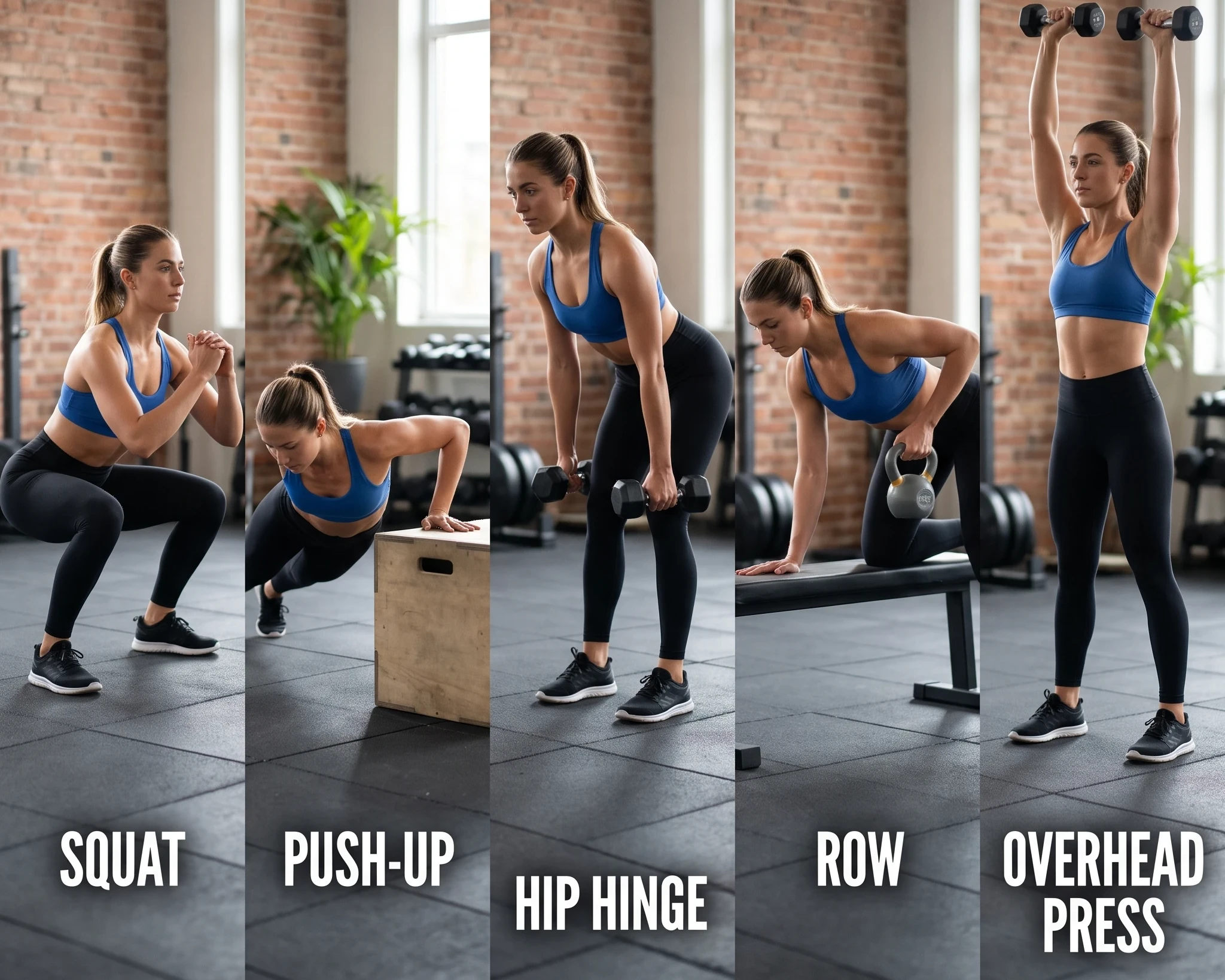
1. Squats
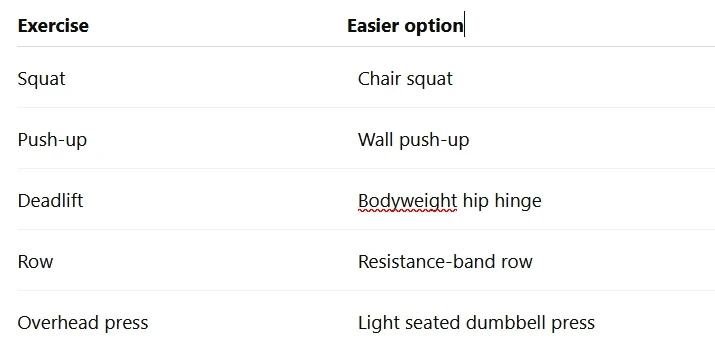
Squats work your legs, hips, and core. If a traditional squat feels difficult, start with chair squats. Sit back toward a sturdy chair and stand again. Once that becomes comfortable, you can progress to body-weight squats and eventually add resistance.
2. Push-ups
Push-ups work your chest, shoulders, and arms. But you don’t have to start on the floor.
Try:
- Wall push-ups
- Incline push-ups using a sturdy surface
- Knee push-ups
- Standard push-ups
Choose the version that allows you to maintain good form.
3. Hip hinge or deadlift
Deadlift movements train your hips, glutes, and the muscles along your back. If you’re completely new to the movement, start by learning the hip hinge without weights. Once you’re comfortable with the movement, you can progress to light dumbbells, kettle-bells, or resistance bands.
4. Rows
Rows strengthen the upper back, shoulders, and arms.
You can perform rows using:
- Dumbbells
- Resistance bands
- A cable machine
Resistance-band rows can be particularly useful if you’re exercising at home.
5. Overhead press
An overhead press works your shoulders and arms while also requiring your body to stabilize the movement. Start with light dumbbells or resistance bands. If lifting overhead is uncomfortable or you have a shoulder problem, choose an alternative exercise (a seated chest press or resistance-band chest press) and consider getting individual advice from a qualified professional.
Beginner alternatives
Remember, there’s no prize for doing the hardest version of an exercise. The best exercise is one you can perform safely and consistently.
How to Get Started Safely
If you’re new to strength training, it’s completely normal to feel unsure about what you’re doing. Here are some simple ways to make your first workouts easier.
1. Start with manageable resistance
You don’t need to prove anything by lifting heavy. Start with a weight that allows you to perform the exercise with good control.
2. Focus on technique
Before worrying about how much you’re lifting, learn how the movement should feel. Good technique gives you a better foundation for progressing later.
3. Warm up
You don’t need a complicated 30-minute warm-up. A few minutes of easy movement, such as walking, cycling, or gentle dynamic movements, can help you transition into your workout.
4. Start with one or two sets
You don’t need a huge amount of training volume when you’re beginning. One or two sets of around 8–12 controlled repetitions can be a reasonable starting point for many exercises.
5. Give yourself time to recover
Your muscles need recovery between challenging strength sessions. Sleep, nutrition, hydration, and rest days all contribute to your ability to recover and keep training.
6. Don’t train through sharp pain
Feeling some muscle fatigue or mild soreness after an unfamiliar workout can happen. Sharp, severe, or persistent pain is different. If something hurts in a way that doesn’t feel right, stop the exercise and get appropriate professional advice if needed.
When should you speak to a healthcare professional?
If you have a medical condition, significant joint or muscle pain, a recent injury or surgery, or you’re unsure whether exercise is appropriate for you, it’s sensible to speak with your doctor or another qualified healthcare professional before starting a new training program.
This article provides general fitness information and isn’t a substitute for individualized medical advice.
How Much Weight Should a Beginner Lift?
This is one of the most common questions beginners have. And unfortunately, there’s no single weight that’s right for everyone. A 5 kg dumbbell might feel very light to one person and extremely challenging to another. Instead of choosing your weight based on your age, use your current ability as your guide.
Choose a resistance that allows you to:
- Complete your planned repetitions
- Maintain good form
- Control the movement
- Finish the set feeling challenged but not completely exhausted
When you’re learning a new movement, it’s usually better to start lighter. Once you’re comfortable with the exercise, you can gradually increase the resistance.
Form first. Weight second.
A Simple Beginner Strength Training Workout
You don’t need a fancy workout split to start strength training after 40. A simple full-body workout performed two or three times per week can be a great starting point.
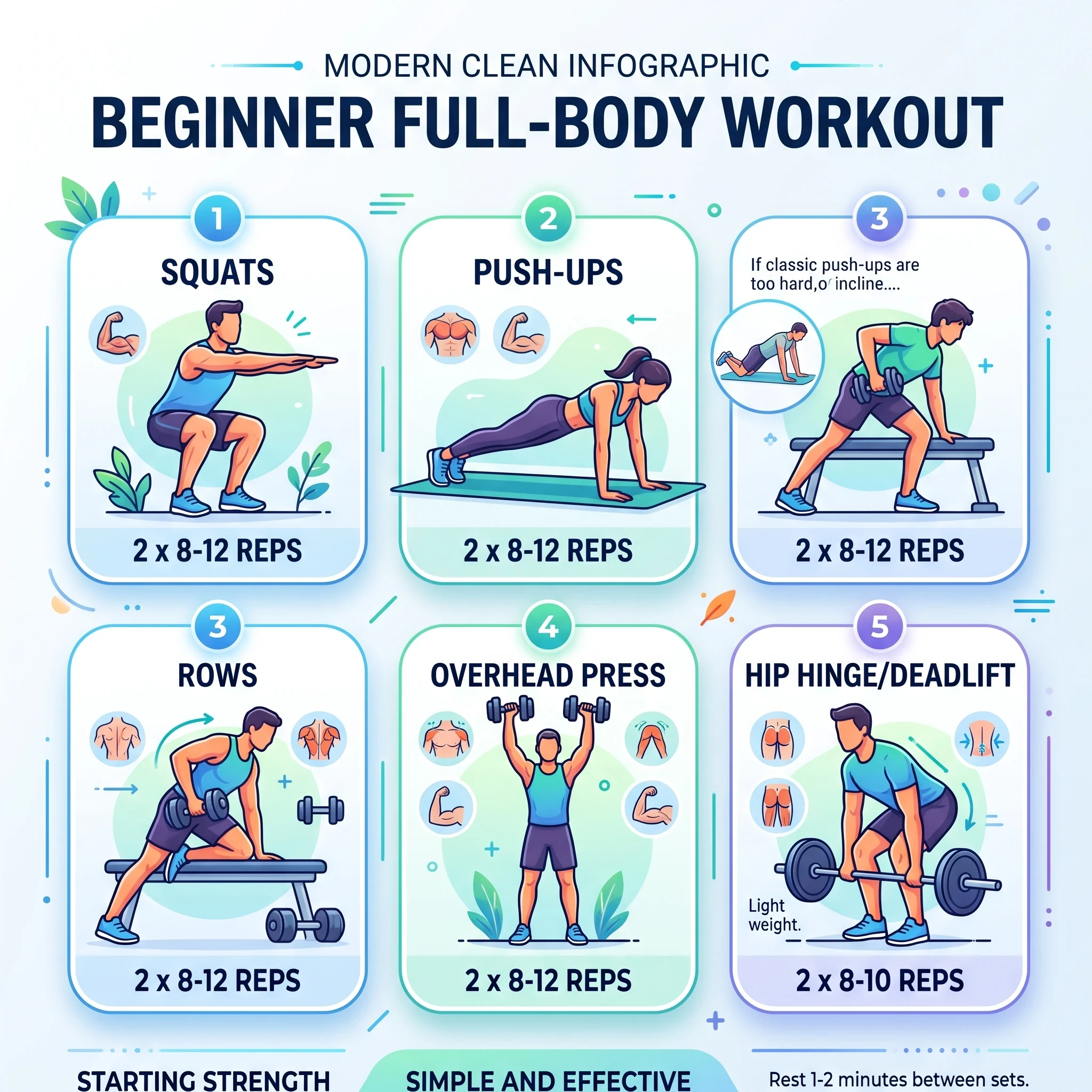
Beginner full-body workout
1. Chair squats or body-weight squats
2 sets × 8–12 reps
2. Wall or incline push-ups
2 sets × 8–12 reps
3. Dumbbell or resistance-band rows
2 sets × 8–12 reps
4. Light dumbbell overhead press
2 sets × 8–12 reps
5. Hip hinge or light deadlift
2 sets × 8–10 reps
Rest between sets and take your time. You don’t need to rush through the workout. For a beginner, a session of roughly 20–40 minutes can be plenty. Choose a resistance that feels manageable at first and becomes challenging toward the end of the set while allowing you to maintain good form. If five exercises feel like too much at first, start with three and gradually build up.
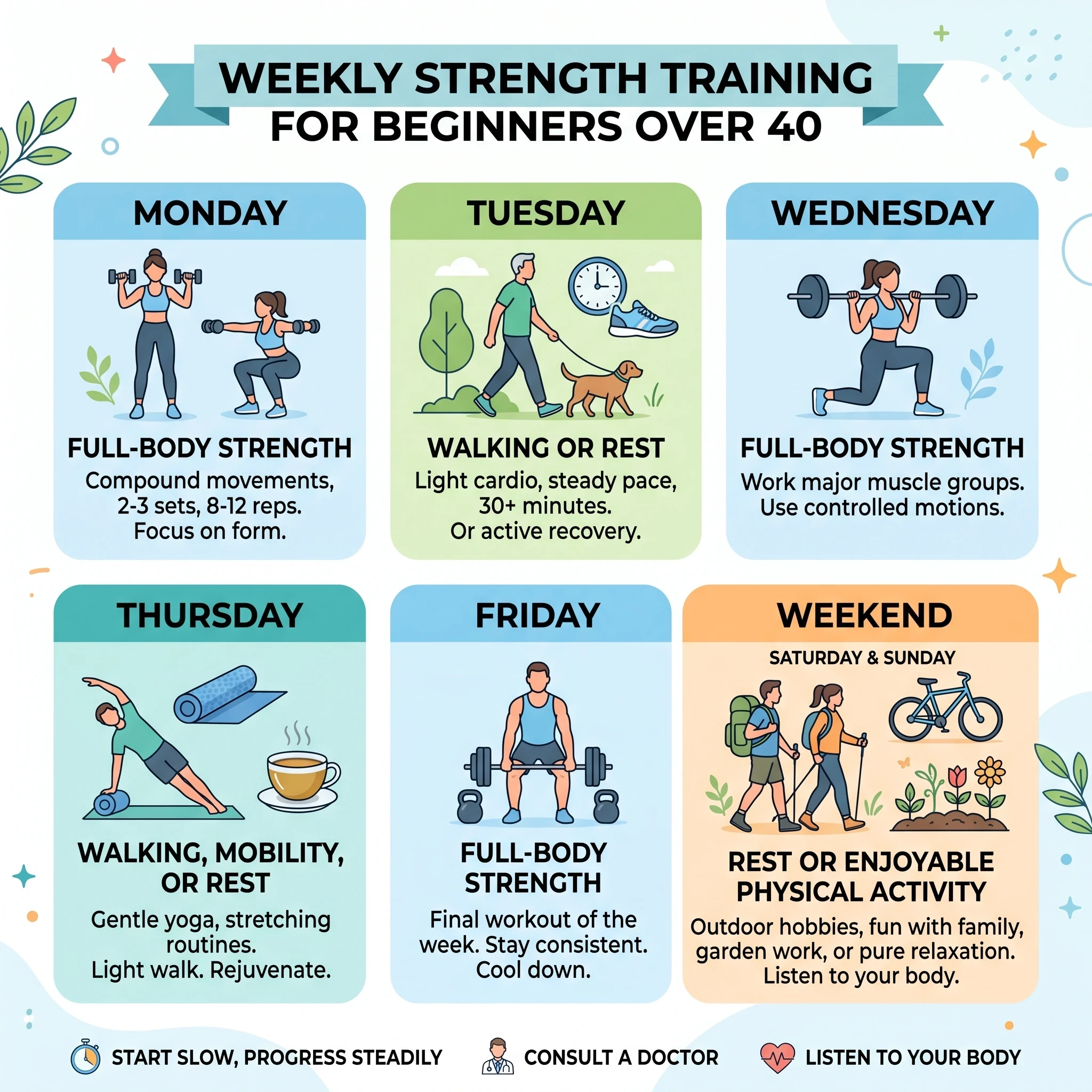
Example weekly schedule
Monday: Full-body strength
Tuesday: Walking or rest
Wednesday: Full-body strength
Thursday: Walking, mobility, or rest
Friday: Full-body strength
Weekend: Rest or enjoyable physical activity
You don’t have to follow this exact schedule. The important thing is giving yourself enough recovery between challenging full-body sessions.
How Often Should a 40-Year-Old Lift Weights?
For many beginners, two to three strength-training sessions per week is a practical starting point. You don’t need to train every day to make progress. In fact, doing less but staying consistent is often much easier to maintain than starting with an ambitious plan and burning yourself out after two weeks. Try to space your full-body workouts across the week.
For example:
Monday + Thursday
or:
Monday + Wednesday + Friday
If you’re very new to exercise, starting with two sessions per week may be enough. As you become fitter and more confident, you can adjust your routine.
Can You Strength Train Every Day?
You can move your body every day, but that doesn’t mean you need to perform hard strength workouts every day. Your muscles need time to recover after challenging training. If you enjoy exercising daily, try alternating different types of movement.
For example:
- Monday: Strength
- Tuesday: Walking
- Wednesday: Strength
- Thursday: Gentle mobility
- Friday: Strength
- Saturday: Easy cycling or walking
- Sunday: Rest
This gives you plenty of opportunities to move while still allowing your body to recover. And remember: rest isn’t being lazy.
Recovery is part of training.
How to Progress Your Strength Training
Once you’ve been training consistently for a few weeks, you may start wondering: “How do I know when it’s time to make my workout harder?” You don’t need to make huge changes. Progress gradually.
You could:
- Add one or two repetitions
- Increase the weight slightly
- Add another set
- Move to a more challenging variation
- Improve your technique
- Increase your range of motion when appropriate
A simple example
Imagine you’re doing dumbbell squats for 8–12 repetitions.
At first, you might manage:
8 reps
After a few workouts:
10 reps
Then:
12 reps with good form
Once 12 repetitions feel comfortable and controlled, you might increase the weight slightly and return to around 8 repetitions. This is a simple form of progressive overload. You don’t have to constantly lift heavier weights.
Small improvements add up.
Helpful Tips and Common Challenges
Start slower than you think you need to
One of the easiest mistakes beginners make is doing too much too soon. You finish your first workout feeling amazing, decide you’re going to train six days a week, and then spend the next three days wondering why walking downstairs hurts. You don’t need to do that.
Start manageable.
Don’t compare yourself with other people
The person lifting weights next to you may have been training for ten years. You’re seeing their chapter 10 while you’re starting chapter 1.
Just focus on your own progress.
Choose exercises you actually enjoy
You don’t have to use barbells if you don’t like them.
You can use:
- Dumbbells
- Resistance bands
- Kettlebells
- Machines
- Bodyweight exercises
There are plenty of ways to get stronger.
Keep track of your progress
A simple notebook is enough.
Write down:
- Exercise
- Weight
- Repetitions
- Sets
- How you felt
After a few weeks, you’ll have something really encouraging to look back on. You may discover that the weight that once felt heavy now feels easy. That’s progress!
Don’t expect every workout to feel amazing
Some days you’ll feel strong and other days you’ll feel tired. That’s normal. A successful fitness routine isn’t one where every workout is perfect. It’s one you can keep coming back to.

Frequently Asked Questions
Can I still build muscle at age 40 or older?
Yes. Adults can build muscle and strength through resistance training well beyond their 40s. Progress can vary depending on factors such as your training history, nutrition, recovery, and individual circumstances. The key is consistent training and gradually increasing the challenge.
What is a good beginner strength training workout after 40?
A simple full-body workout two or three times per week can be a good place to start.
You could begin with:
- Squats or chair squats
- Push-ups or wall push-ups
- Rows
- Overhead presses
- Hip hinges or light deadlifts
Start with manageable resistance and focus on good technique.
What are the 5 basic strength exercises?
Five useful foundational exercises for beginners are:
- Squats
- Push-ups
- Hip hinges or deadlifts
- Rows
- Overhead presses
You can modify each exercise to match your current fitness level.
Can I strength train every day?
You don’t need to perform challenging full-body strength workouts every day. Give the muscles you’ve trained time to recover and use other days for activities such as walking, gentle cycling, mobility work, or stretching.
How often should a 40-year-old lift weights?
For many beginners, two to three strength-training sessions per week is a practical starting point. Your ideal schedule depends on your fitness level, goals, recovery, and other activities.
How heavy should I lift when starting strength training after 40?
Start with a weight that allows you to perform the exercise with good technique and control. The final repetitions should feel challenging, but you shouldn’t need to sacrifice your form to finish the set. As you become stronger, gradually increase the resistance.
How long should a beginner strength workout be?
You don’t need a long workout to get started. A simple full-body session of around 20–40 minutes can be enough for many beginners, especially when you’re focusing on learning the exercises and building consistency.
Final Thoughts
Starting strength training after 40 doesn’t have to be complicated. You don’t need the perfect workout, expensive equipment, or years of gym experience. You simply need a starting point.
Begin with a few basic exercises. Use manageable resistance. Focus on good technique. Give yourself time to recover and gradually make your workouts more challenging. Most importantly, don’t underestimate what small, consistent efforts can do over time. Your goal isn’t to become a different person overnight.
It’s to become a little stronger, a little more confident, and a little more capable as the weeks and months go by.
And that’s a pretty great reason to start.
Sources & Further Reading
- World Health Organization (WHO). WHO Guidelines on Physical Activity and Sedentary Behaviour — evidence-based recommendations covering physical activity, frequency, intensity and duration for adults and older adults.
- National Institute on Aging (NIA). Exercise and Physical Activity — information about exercise, healthy aging, staying active safely, and the benefits of physical activity.
- National Institute on Aging (NIA). How Can Strength Training Build Healthier Bodies as We Age? — information on strength training, muscle mass, mobility and maintaining physical function as we age.
- American College of Sports Medicine (ACSM). 5 Things to Know About Creating an Effective Resistance Training Plan — current 2026 guidance on resistance training, consistency, progression and training major muscle groups.
Hi, my name is Iris, and I’m the founder of SimpleFitSteps. I write beginner-friendly fitness content focused on helping women over 40 become stronger, fitter, and healthier without complicated workout routines
I’m currently studying to become a personal trainer and weight consultant, and I use what I’m learning to create practical, easy-to-understand articles that I hope will be helpful to you, the reader.
You can read more about me in the about me section