

Most weeks don’t fall apart because you forget to exercise. They fall apart because a meeting runs long, someone gets sick, the car needs an unplanned trip to the garage, and by Thursday the version of the week you planned on Sunday no longer exists. A workout plan that only works when nothing goes wrong was never going to survive a real week.
Staying consistent with exercise when you’re busy isn’t about finding more willpower. It’s about building a plan with a built-in fallback, so a disrupted Tuesday doesn’t turn into a cancelled week.
Why “all or nothing” is what actually derails busy weeks
The plan that says “45 minutes, five days a week” sounds solid on a Sunday evening. Then Tuesday brings a late meeting, and the 45 minutes doesn’t happen. By Wednesday, the thinking shifts from “I missed one” to “I’ve already ruined the week,” and the whole plan quietly gets shelved until next Monday.
That shift in thinking is the real damage, not the missed Tuesday. One gap doesn’t mean the plan has failed. It means a single day didn’t go as planned, which happens most weeks for anyone juggling work and family.
A plan with a smaller version built in holds up when the week gets messy. A plan that only works at full size falls apart the first time something changes your schedule. The fix is deciding, in advance, what the smaller version looks like.
The 10 minute non-negotiable
Before the week gets hard, decide what “enough” looks like on a bad day. Not the ideal day. The floor.
For most people, that floor is around 10 minutes: a short strength circuit, a brisk walk around the block, a handful of mobility moves on the bedroom floor. It doesn’t need to be impressive. It needs to be short enough that “I don’t have time” stops being a believable reason to skip it.
The value of the 10 minute non-negotiable isn’t the fitness progress on its own, although that adds up over time. The value is that it keeps the habit alive. Moving a little most days keeps the habit of moving. Moving a lot some weeks and nothing in other weeks means restarting the habit every time, and restarting is where most people quietly stop altogether.

Decide now what your 10 minutes looks like, so you’re not negotiating with yourself at 9pm on a Wednesday when you’re exhausted. Write it down somewhere you’ll see it.
Build the backup plan on a calm day, not a chaotic one
A backup plan built in the middle of a chaotic week usually gets skipped, because skipping is the easiest option in the moment. Build it when things are calm instead. Pick a Sunday, or any quiet evening, and answer these questions while you have the headspace:
- What does my 10 minute version actually involve, step by step?
- Where in my home or routine can it happen without extra setup?
- What equipment, if any, does it need, and is that equipment already within reach?
Write the answer down. Keep it somewhere obvious: a note on your phone, a card on the fridge. A plan you have to reconstruct from memory during a stressful moment rarely gets used. A plan you can glance at and follow usually does.
Three workouts that fit into gaps you already have
You don’t need a free hour to train. You need a few minutes you’re already losing to something else.

While the kettle boils or dinner is in the oven. A set of body weight squats, some wall push-ups, a minute of marching on the spot. Three or four minutes, done standing in the kitchen, no equipment required.
During a work call you don’t need to be on camera for. Light stretching, gentle mobility work for hips and shoulders, or standing calf raises while you listen. Nobody on the call needs to know.
The first 10 minutes after you wake up, before the day gets to your calendar. This is often the most reliable slot of the day, because it happens before anything else has the chance to run long. If you want a ready-made version of this, the 20 minute morning strength routine is built to work in exactly this kind of gap, and you can always do half of it on a tighter day.
None of these need a gym bag or a change of clothes. The fewer steps between “I have a few minutes” and “I’m moving,” the more likely it actually happens. You can stack a few more minutes onto things you’re already doing, too: calf raises while you brush your teeth, mobility stretches during a show, squats on ad breaks, or balancing on one leg while the kettle boils. None of this replaces a full workout, but on a week where a full workout isn’t happening, these stacked minutes keep your body moving and the habit intact. If joints are part of what you’re managing, pairing this with mobility exercises for joint health can help keep things comfortable even on the busiest days.
What to do after you miss two days in a row
Two missed days is not a crisis. It’s a normal part of a normal week, and the only real mistake is treating it as proof the plan has failed.

When you notice it’s been two days, don’t try to make up for lost time with a long, punishing session. That thinking is the all-or-nothing pattern returning, and it usually leads to either an injury from doing too much too soon, or a third missed day because the makeup session feels too big to start.
Instead, go straight back to the 10 minute non-negotiable. Not the full plan. The floor. The goal after a gap is to move today, in whatever small way fits, and let tomorrow take care of itself. Consistency is built by how quickly you return, not by how perfect the previous stretch was.
A simple weekly template for weeks you can’t predict
A rigid schedule assumes a calm week. What holds up better is a flexible structure that still works when the week doesn’t go to plan. Something like this suits most busy weeks:
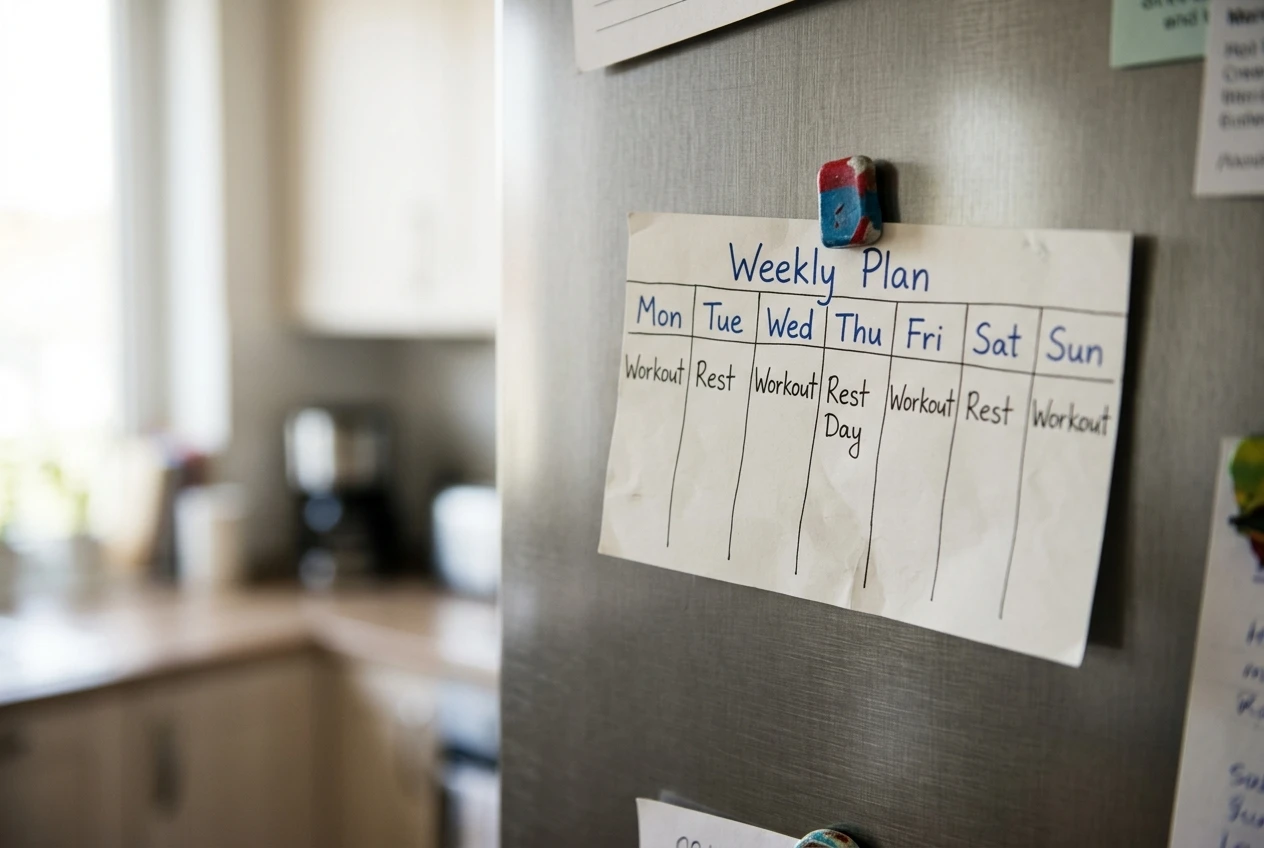
- 2 days: a full session, whatever length currently suits you, strength or cardio depending on what your week allows.
- 2 to 3 days: the 10 minute non-negotiable, done wherever it fits.
- Every day, regardless of the above: a few stacked minutes attached to something you’re already doing.
- 1 day: deliberate rest, planned rather than forced on you by a missed workout.
This template adjusts around a busy week instead of breaking against it. Some weeks you’ll hit the full sessions easily. Other weeks you’ll lean almost entirely on the 10 minute version and the stacked minutes, and that’s not a lesser week. That’s the plan working the way it’s meant to.
If this week is already full, start with the 20 minute morning strength routine linked above. It’s built for exactly this kind of week.