
Nobody sits you down in your forties and tells you what’s actually happening to your muscle. There’s no appointment for it, no warning letter. You just notice one day that the jar won’t open as easily, or the stairs feel steeper than they used to, and you assume you’re tired, or busy, or getting older in some vague, general way. What’s really going on is more specific than that, and it’s worth understanding why muscle mass matters after 40, because the fix is simpler than most of what gets marketed to women our age.
The quiet loss nobody warns you about
Starting somewhere in your thirties, and picking up speed after forty, your body begins losing muscle tissue on its own, without you doing anything to cause it. Researchers call this sarcopenia. It doesn’t announce itself with pain or an injury. It just accumulates, year over year, until one day the gap between what your body used to do without thinking and what it can do now has become impossible to ignore.
Menopause speeds this along. The hormonal shifts that show up in your forties and fifties affect muscle maintenance directly, not just mood and sleep. So the timing isn’t a coincidence: the decade when muscle naturally wants to leave is often the same decade when your hormones stop helping you hold onto it.
Here’s the part that matters most: this loss is not inevitable in the way grey hair is inevitable. Muscle responds to signals. Give it a reason to stay, through resistance and load, and it stays. Give it no reason, and it leaves quietly, a little every year, until the day you need it and it isn’t there.
Muscle as insurance: how it protects the things you actually care about later
Think about what you actually want at seventy, or eighty. Probably not a visible six-pack. Probably: to live in your own home, to travel without needing help at the airport, to pick up a grandchild, to not dread a flight of stairs. Those outcomes depend less on luck than on a tissue most of us never think about until it’s gone.
Muscle is the thing standing between you and needing help for ordinary tasks. It’s what lets you catch yourself instead of falling. It’s what gets you off the floor after you’ve been gardening, and back up a curb without grabbing a railing. None of that shows up on a bathroom scale, which is exactly why it gets ignored for so long.

An insurance policy is something you pay into now so it’s there when you need it later, often decades later, often for a version of you that doesn’t exist yet. Muscle works the same way. The sets you do this week aren’t really for this week. They’re a deposit toward the woman who, twenty years from now, still carries her own suitcase.
The independence test: carrying groceries, climbing stairs, getting up off the floor
There’s a simple way to check where you actually stand, and it has nothing to do with how you look in a mirror. Can you carry a full bag of groceries in each hand from the car to the kitchen without stopping? Can you climb two flights of stairs without your legs burning by the top? Can you lower yourself to the floor and get back up without using your hands to push off?

These aren’t fitness test questions designed to make you feel bad. They’re real tasks that real lives are built from, and they get harder every year muscle is allowed to decline unchecked. The encouraging news is that each one responds to the same intervention. You don’t need separate training for “grocery strength” and “stair strength” and “floor strength.” You need muscle, broadly, in your legs, hips, back and arms, and it carries over into all of it.
If you haven’t started building that yet, how to start lifting weights at home safely is a reasonable place to see what that actually looks like in practice, without needing a gym or equipment you don’t already own.
Muscle and metabolism: why it matters for blood sugar and energy, not just appearance
Muscle isn’t just a passive structure holding you upright. It’s active tissue, constantly pulling glucose out of your bloodstream to use as fuel. The more muscle you carry, the more capacity you have to absorb and use the sugar from the food you eat, which matters a great deal for blood sugar stability as you move through your forties and fifties, when insulin sensitivity tends to shift.
This is also tied to energy. The afternoon crash, the feeling of running on empty by 3pm, is sometimes a blood sugar story as much as a sleep story. Muscle, by giving your body somewhere productive to send that glucose, plays a quiet part in evening out the swings that leave you reaching for coffee or a snack to get through the rest of the day. If energy is the piece you’re most trying to solve for, how to increase energy levels after 40 goes deeper into the daily habits that support it alongside your training.
Muscle also keeps your resting metabolism higher than it would otherwise be, simply because muscle tissue burns more at rest than fat tissue does. That’s worth knowing, but it’s a secondary benefit. The blood sugar and energy piece is the one that actually shapes how you feel, day to day, for decades.
Falls, fractures, and why muscle matters as much as bone
Bone density gets most of the attention when the conversation turns to aging, and it deserves attention. But bone is only half the story. A fall happens because something gives way before a bone ever breaks, and that something is almost always muscle: the strength to catch your balance, to react quickly enough, to stop a stumble before it becomes a fall.

Strong bones and weak muscles still leave you vulnerable, because muscle is your first line of defense against the fall itself, and bone density only becomes relevant after that defense has already failed. Train both, and you cut your risk from two directions instead of one. If you want the specifics on exercises that work directly on bone, best dumbbell exercises for bone density pairs well with the muscle-building work this article is making the case for.
This is why a fall in your seventies can change the whole shape of someone’s life, while the same stumble in your thirties barely registers. The muscle that would have caught it quietly disappeared years earlier, without anyone noticing it was gone.
How much is enough: a realistic, non-scary way to think about your muscle “account”
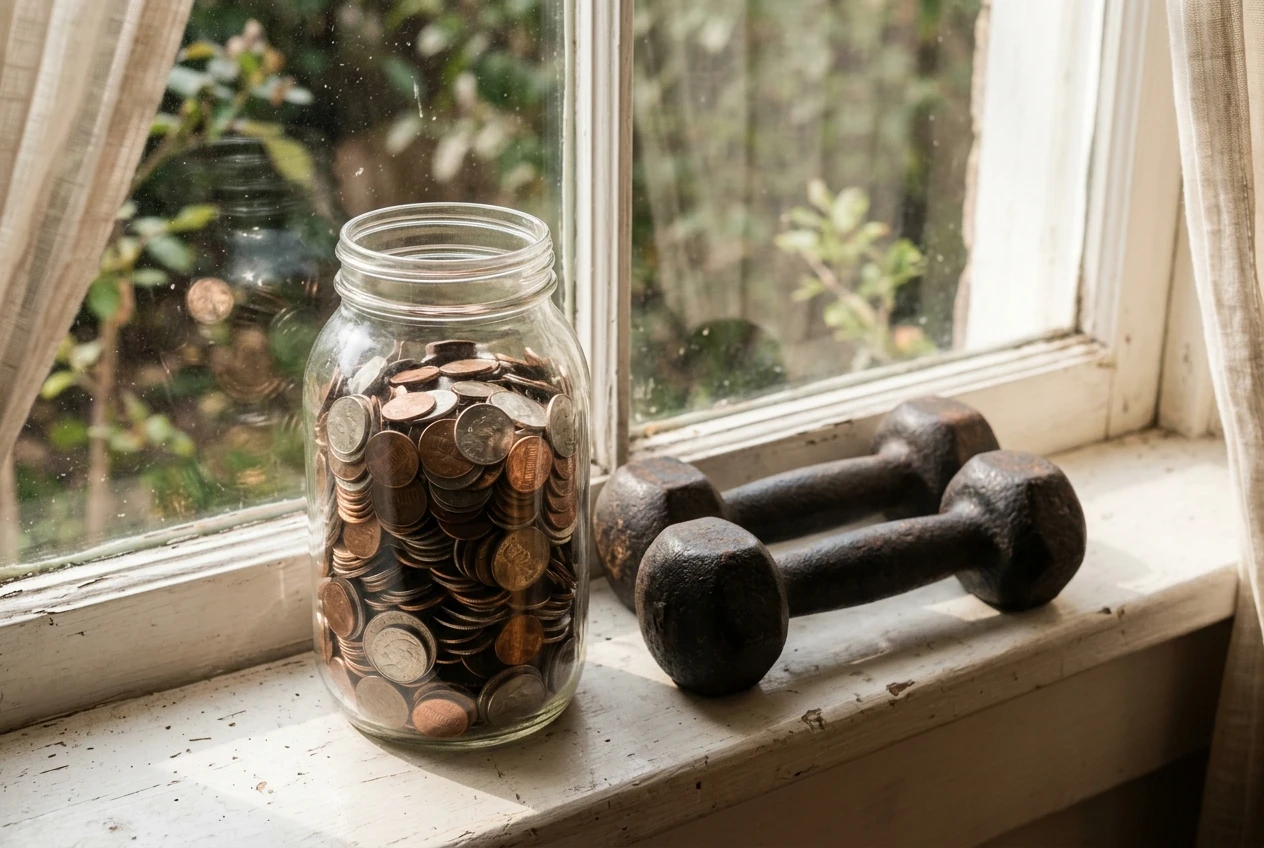
You don’t need to train like an athlete to protect yourself. Think of it as a savings account rather than a sprint. Two or three sessions a week of resistance work, consistently, across months and years, is what builds and maintains the balance. There’s no finish line where you’re “done,” the same way there’s no point where you stop needing to eat.
What matters more than any single workout is the deposit habit itself. Missing a week here or there doesn’t wipe out the account, but months of total inactivity will start to draw it down. If consistency, not motivation, is your actual obstacle, how to stay consistent with exercise when busy addresses that directly, because knowing why muscle matters and actually keeping the habit going are two different problems.
Where to start if this lit a fire under you
Understanding why muscle matters is the easy part. The honest next question is how to start building it without hurting yourself or guessing your way through it. How To Start Strength Training After 40 walks through exactly that, as the practical next step for turning this insurance policy from an idea into something you’re actually building, one session at a time.