
Most of us assume we will remember how many days we moved this week. We will not, not accurately. By Thursday, Monday already feels like it happened last week or didn’t happen at all, and by the following Monday the whole picture has blurred into a vague sense of “I think I did okay.” That vague sense is where a lot of frustration with exercise actually starts, not because the effort wasn’t there but because there was no record of it.
A simple fitness habit tracker for beginners fixes that. Not a complicated app with graphs and streak badges and reminders that make you feel bad when you miss a day, just a plain, honest record of what you actually did. This article walks through exactly what to track, how to set it up, and how to read it back so you can see your own consistency in black and white instead of guessing at it.
Why tracking beats trusting your memory
Memory is selective, and it tends to be selective in the direction that matches your mood. On a day when you’re feeling discouraged, you’ll remember the workouts you skipped. On a day when you’re feeling good, you’ll round up and assume you did more than you did. Neither version is reliable, and neither one gives you anything to actually learn from.
A tracker removes the guesswork. It’s a written fact instead of a feeling, and facts are much easier to work with when you’re trying to build a habit. Instead of asking “have I been consistent lately?” and getting an answer shaped by whatever kind of day you’re having, you can look at a page and see the actual pattern.
This matters even more when the scale or the mirror isn’t telling you anything useful yet, which is often the case in the early months. Consistency shows up before results do, and a tracker is the only way to see it happening.
The three things worth tracking (and the dozen you can ignore)
Most habit trackers fail because they ask you to log too much. Minutes, calories, heart rate, mood, sleep, water, steps. By day four you’re spending more time filling in boxes than exercising, and the whole thing gets abandoned.
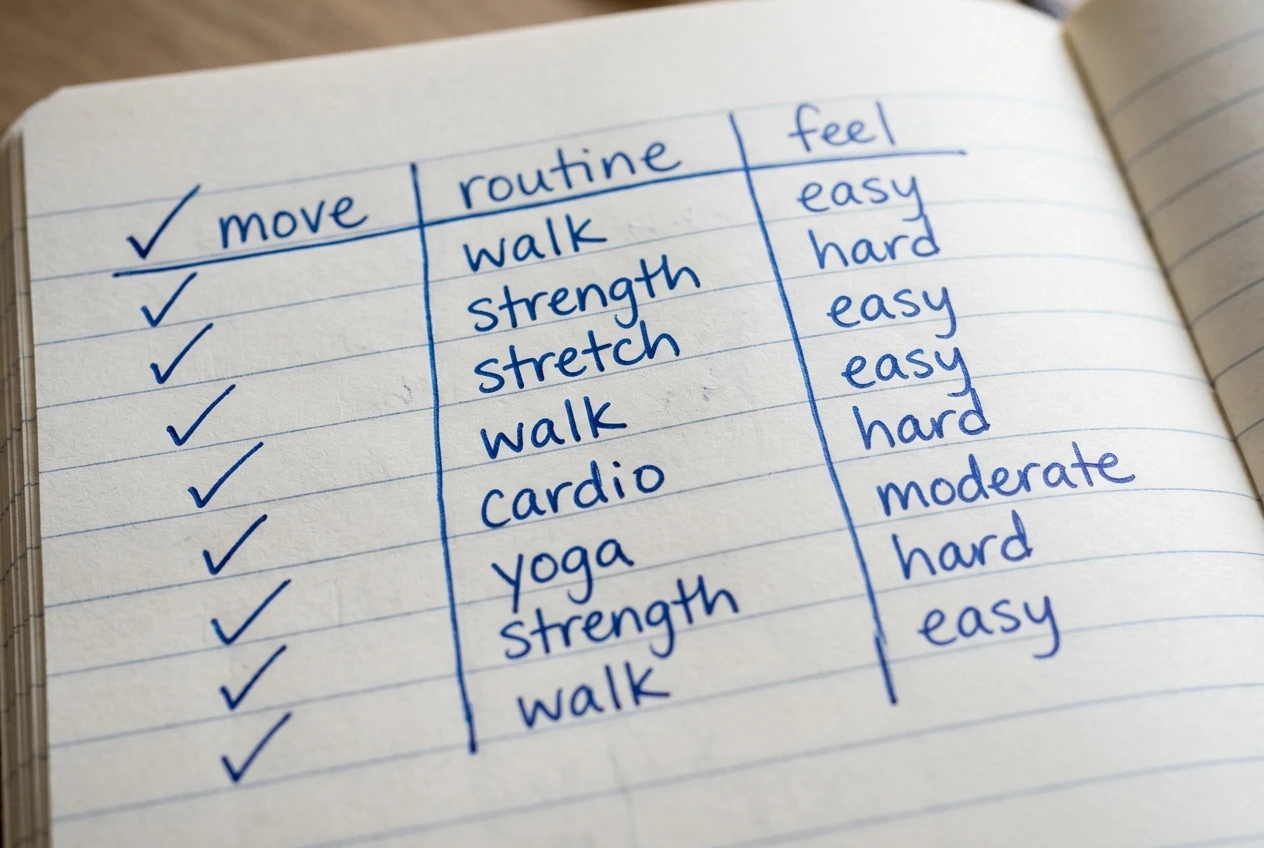
Track three things, and nothing else:
- Did you move today? Yes or no. It doesn’t matter if it was a full workout or a 15 minute walk. Movement counts.
- What kind? A single word is enough: strength, walk, stretch, cardio. This isn’t for analysis, it’s just so you can glance back and see variety or notice when one kind has disappeared entirely.
- How did it feel? A simple scale, like easy, good, or hard. This isn’t about performance, it’s about noticing patterns, like whether certain days of the week consistently feel harder, which often points to something worth adjusting, like sleep or timing.
That’s it. No duration, no intensity percentages, no detailed notes. The point of this tracker is to show you consistency, not to turn exercise into a data project.
Building your tracker: paper, spreadsheet, or app
The format matters far less than you’d think. What matters is that you’ll actually use it.
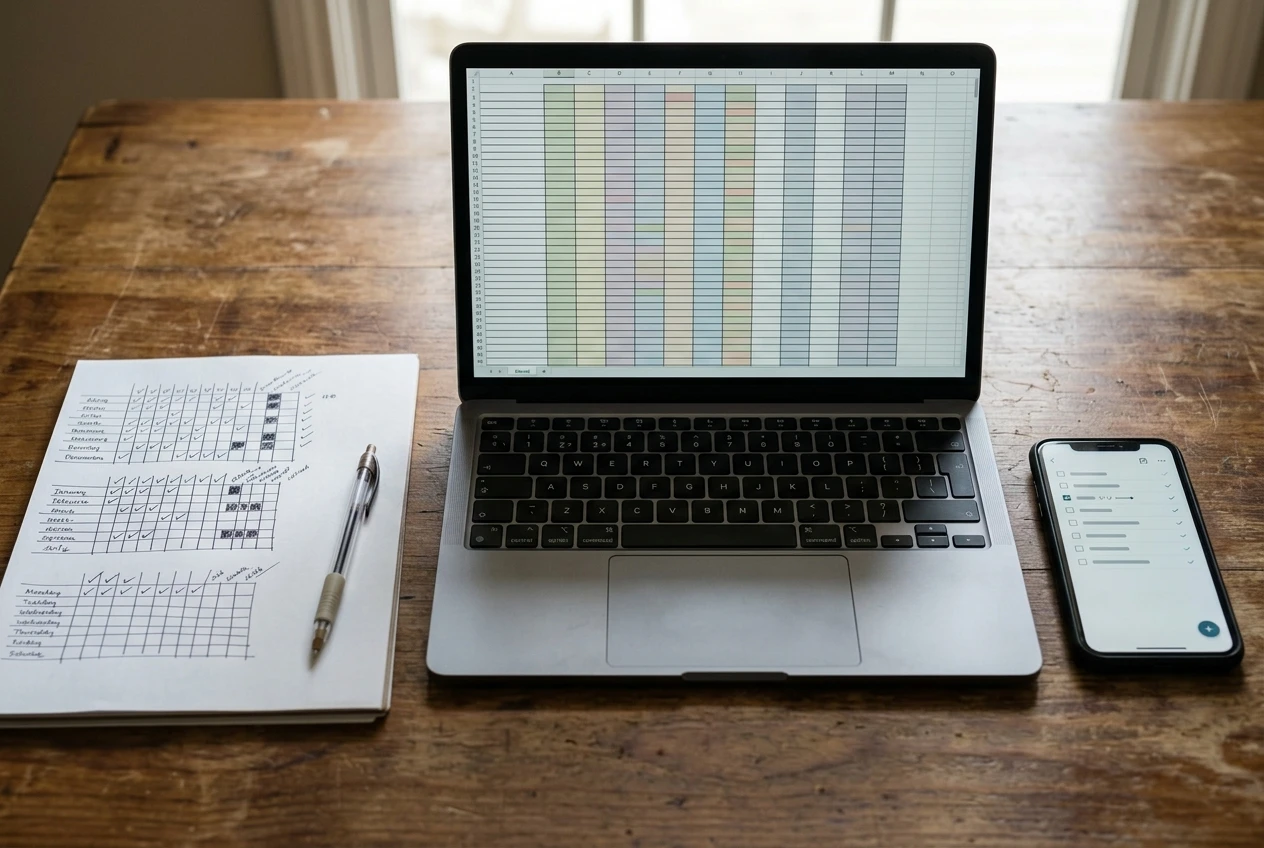
Paper works well if you like something you can see without opening a device. A simple grid on a piece of paper taped inside a cupboard door or kept next to your coffee maker, with the days of the month down one side and your three columns across the top, takes five minutes to make and lasts the whole month.
A spreadsheet suits you if you’re already comfortable with one and like being able to see totals add up automatically. You don’t need formulas, just rows for days and columns for the three things you’re tracking.
An app can work too, if you already have one you like and it doesn’t bury the simple version under features you don’t need. If you’re still deciding which workout app fits how you actually train, this guide to choosing a workout app that fits is worth a look before you commit to one just for tracking.
Whichever you pick, keep it visible. A tracker buried in a drawer or a folder three taps deep on your phone won’t get filled in. It needs to be somewhere you walk past or open naturally, as part of your day, not a special errand.
Marking a day in under a minute

This should take less time than it takes to read this sentence twice. Write the date if it isn’t already printed, mark yes or no for movement, write one word for the kind, and circle or write one word for how it felt. Done.
The temptation is to add more: what you ate, how your knee felt, a note about being tired. Resist it. The moment logging starts to feel like homework is the moment it stops happening. Keep it fast enough that you can do it standing in the kitchen with the kettle on, because that’s realistically when it will happen most days.
If you miss a day of logging, just back-fill it from memory the next time you sit down with it. Don’t let a missed log entry turn into an excuse to abandon the whole page.
Reading your month: what a good pattern actually looks like
At the end of three or four weeks, look back at the whole page at once rather than day by day. This is where the tracker actually earns its keep.
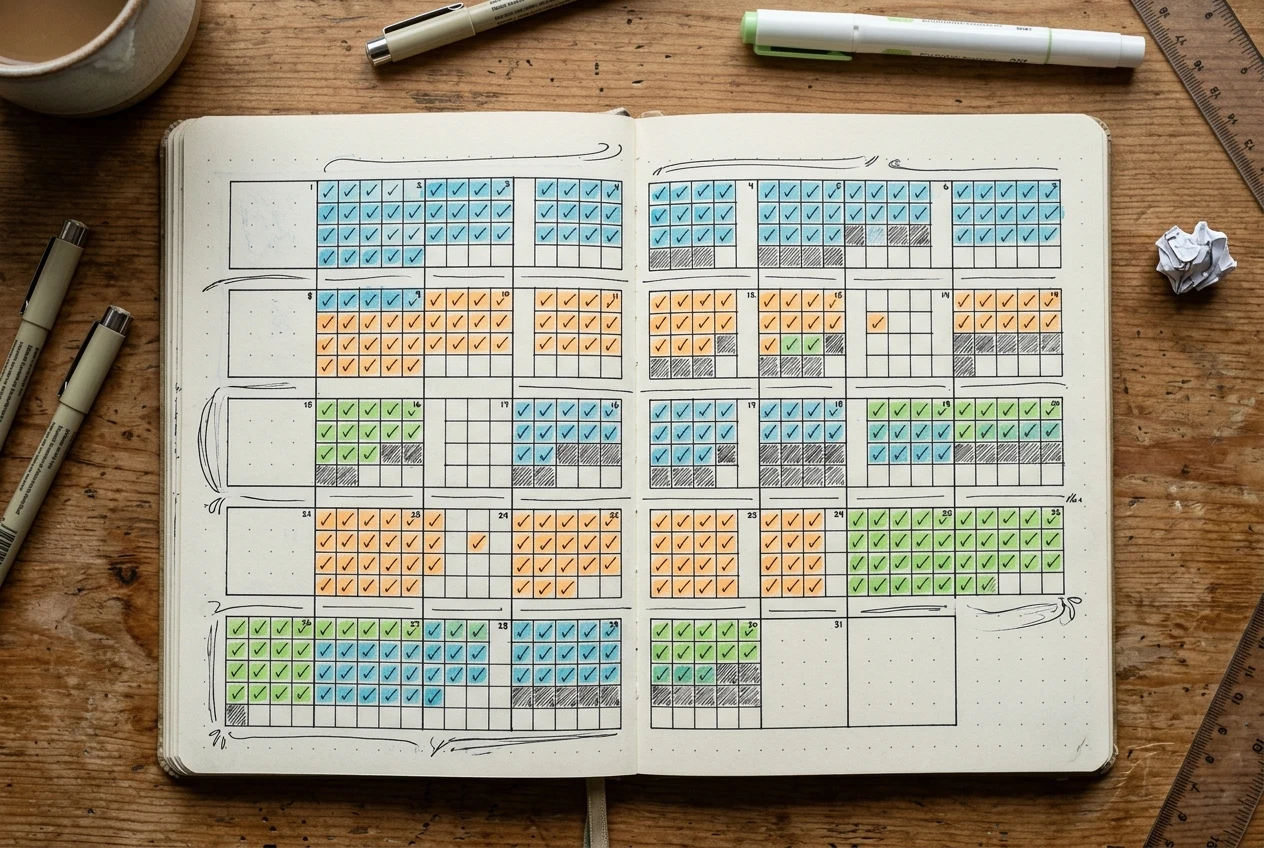
A good pattern rarely looks like a straight run of yeses. It usually looks more like clusters: three or four days of movement, a gap, another cluster, maybe a longer gap around a busy week, then movement again. That’s not failure, that’s what real life with exercise actually looks like for most people.
What you’re looking for isn’t perfection, it’s whether the clusters keep returning. If every gap is eventually followed by more movement, the habit is holding. If the gaps get longer and the clusters get shorter as the weeks go on, that’s useful information too, and it’s much easier to catch in a page of marks than in memory.
Also look at the “how did it feel” column. If most days are landing on hard, that’s worth paying attention to. It might mean the routine needs to ease back, or that something outside exercise, like sleep or stress, is working against you. If you’re also dealing with the kind of fatigue that doesn’t seem to match your effort, the habits that matter more than your workout for energy after 40 is a good next thing to read.
What to do when the tracker shows gaps
Gaps will happen. The point of the tracker isn’t to shame you when they do, it’s to show you where they are so you can respond to them instead of just feeling vaguely guilty about them.
When you see a gap longer than about five or six days, don’t try to make up for it with a harder session. Just pick back up at the same level you left off. The tracker’s job here is simply to make the gap visible early, before it turns into a month, rather than to assign blame.
If gaps keep showing up around the same point in the week, that’s a pattern worth acting on rather than ignoring. Maybe Wednesdays are always the day everything else gets scheduled first. Knowing that lets you plan around it, like moving that day’s movement to the morning before the rest of the day fills up. If busy weeks in general tend to be where your consistency breaks down, this piece on staying consistent during busy weeks covers that specific problem in more depth.
Making it a habit that outlasts week one
The habit of tracking outlasts week one for the same reason the habit of moving does: it gets attached to something you already do. Keep the tracker somewhere that sits next to an existing routine, like your coffee maker, your nightstand, or the spot where you put your water bottle after a workout, so marking it becomes part of a motion you’re already making rather than a separate task to remember.
Don’t let a missed log day become a reason to start over on a fresh page or a new app. The gaps in the tracker are part of the record, not a reason to throw it out. A tracker with a few blank days and three months of entries is far more useful than three perfect weeks followed by an abandoned page.
Start this week. Grab a piece of paper, a notes app, or a spreadsheet, and mark today: did you move, what kind, how did it feel. If you want an easy, low pressure place to start logging something, the 20 minute morning strength routine is a simple one to begin with, something short enough to fit before the day gets busy and worth marking down the moment it’s done.